Most beginners pick an online bass course the way they pick a pair of shoes: by what looks good in the ad. A better method is to decide what the first three months of playing require and then check each type of lesson against that list. This comparison covers the four main formats: video course platforms, subscription apps, one-to-one video lessons and free YouTube. It judges each against the needs of a complete beginner.
It names no specific brands and quotes no prices, because both change often and the type of lesson matters more than the logo. Check current pricing and terms on any site before you pay.
What a beginner needs from online bass lessons in the first 90 days
The first 90 days decide whether you keep playing. During that time you build a few physical habits, learn to keep time, and play something recognizable. Four things help you do that.

- Feedback. Bass is physical. Wrist angle, thumb position, how hard you fret and how cleanly you mute all affect your sound, and you cannot hear your own mistakes reliably at the start. Someone or something has to tell you.
- Structure. A beginner does not know what to learn next. A sequence that goes from open strings to the fretboard to simple rhythms to full bass lines saves you from jumping between topics.
- A clear first-song path. Playing along with real music keeps motivation up. The best path starts with root notes, steady eighth notes and a handful of positions, so your first song arrives within weeks.
- A cost you can walk away from. Many people drop an instrument within the first few months. A format that locks you into a long prepaid plan punishes that. One you can stop on short notice does not.
No single format covers all four. The sections below show where each one is strong and where it leaves gaps.
If you have not bought your bass yet, the affordable bass guitars for beginners page covers what to look for. Lessons go much better on an instrument that stays in tune and is comfortable to hold.
The four ways to learn bass online, and who each one suits
Each format is built around a different strength.
- Video course platforms sell a pre-recorded curriculum, either course by course or through a membership. They suit people who want a clear sequence and like to study alone.
- Subscription apps and play-along tools turn practice into exercises, songs and scrolling notation, often with some form of scoring. They suit people who learn by doing and want a reason to open the bass every day.
- One-to-one video lessons put you on a call with a teacher who watches you play. They suit people who want correction and are willing to pay more per hour for it.
- Free YouTube lessons cost nothing and cover almost every topic. They suit people on a tight budget who can sort good material from bad and put it in order themselves.
These formats can be combined. The final sections cover pairings that work well.
Video course platforms: structure and value, and where they leave you stuck
A good video course is an organized curriculum. A teacher walks you through setup, posture, the notes on each string, simple rhythms and a first set of bass lines, usually with practice material to download. For a beginner the main gain is that someone else has already decided the order. You do not have to ask what comes after learning the notes on the E string, because the next lesson tells you.
Value is the other strength. Because the teacher records once and sells many times, the cost per hour of instruction is usually far lower than live tutoring. Many platforms let you re-watch lessons whenever you like, so you can go back over a technique that did not click the first time.
The weakness is that nobody watches you play. A course can tell you to keep your thumb anchored behind the neck and your fretting fingers close to the frets. It cannot see that your wrist is bent sharply or that your open strings ring because your fretting hand is not muting them. Some platforms add a community forum or occasional video review, and these vary a lot in how useful they are. Look at what is actually offered before you assume it exists.
Pace is the second risk. Self-paced means nobody notices when you stop. If a course sells you a year of access, you may stop opening it in week three and still be paying.
Best for: self-motivated beginners who want a curriculum and are willing to film themselves now and then to check their own technique.
Check before buying: whether there is any feedback channel, how long you keep access, and what the cancellation terms are if you pay by subscription.
Subscription apps and play-along tools: what they teach well and what they skip
Apps are good at the things that reward repetition. They can show a note, tell you when you hit it, scroll tabs or notation at a set tempo and give you a song to play along to. That is useful for building fretboard knowledge, getting your fingers moving and making daily practice feel like progress. Some beginners play more often with an app because the next task is always obvious.
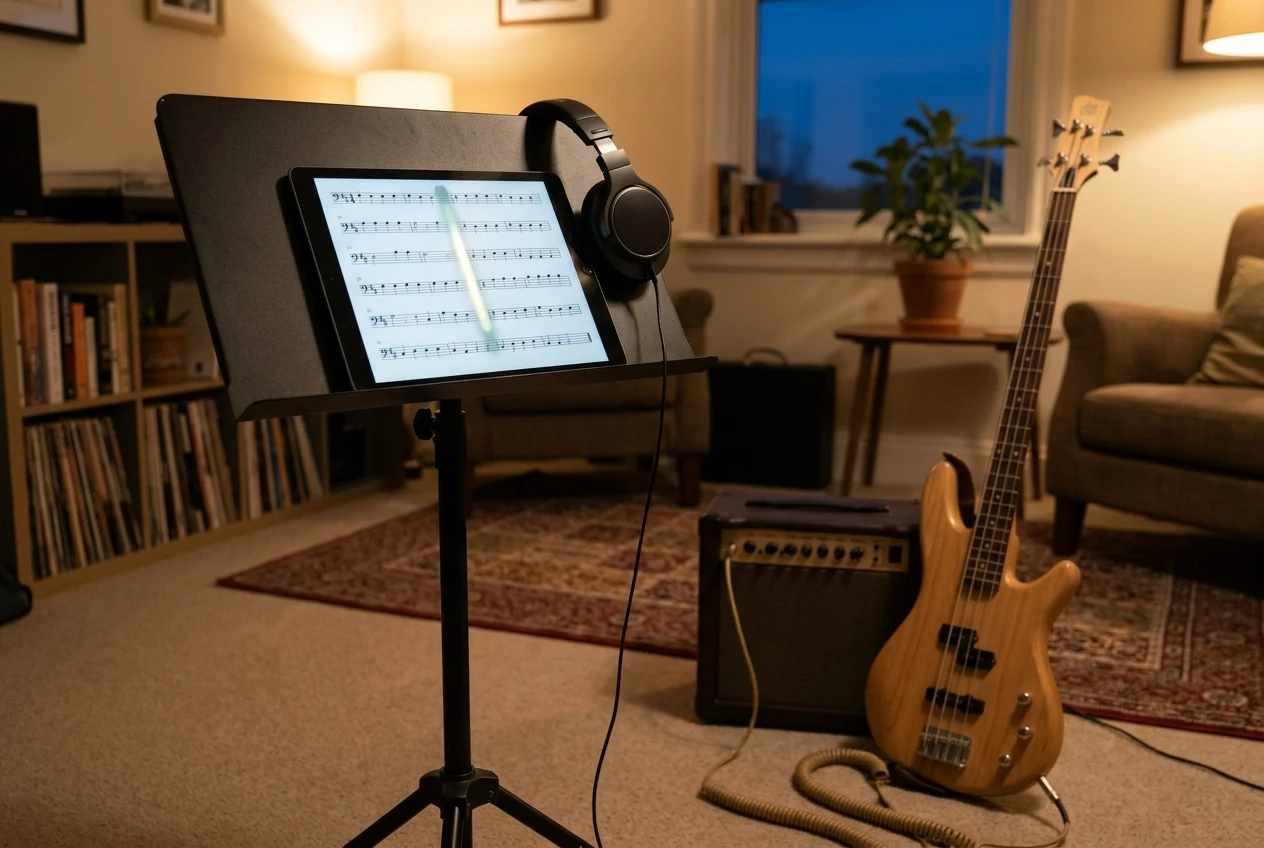
Apps are good at playing along with a track, and playing along matters. It forces you to keep time with something that does not wait for you, which is a core bass skill. If the app lets you slow a track down without changing pitch, that is a real aid when a part is too fast.
What apps tend to skip is technique. Many detect pitch and timing but cannot tell whether your hand position is sound or whether your muting is clean. You can score well and still build habits that cause trouble later: a tense fretting hand, rushed notes or uneven fingerstyle. Apps also vary in how well they teach why a bass line works. Learning a line note by note is different from understanding that the notes follow the chord, and that understanding is what lets you make up lines of your own.
Another point to check is the song library. The path to a first song depends on whether the app has songs at your level that you actually want to play. A large library full of songs far beyond a beginner does not help.
Best for: beginners who need a daily habit and enjoy a game-like format, especially those who pair the app with another source of feedback.
Check before buying: a trial period, whether you can cancel monthly, and whether the beginner songs are ones you would listen to.
One-to-one video lessons: the only option with real feedback on your technique
A live teacher is the one format that closes the feedback gap. On a video call, a good teacher can see your hands, hear your tone and stop you the moment a bad habit forms. They can change the plan around your goals, whether that is rock, funk, worship band or just playing along to records. They can also spot a problem you have no way of noticing, like the thumb that keeps drifting or the plucking finger that digs in too hard.
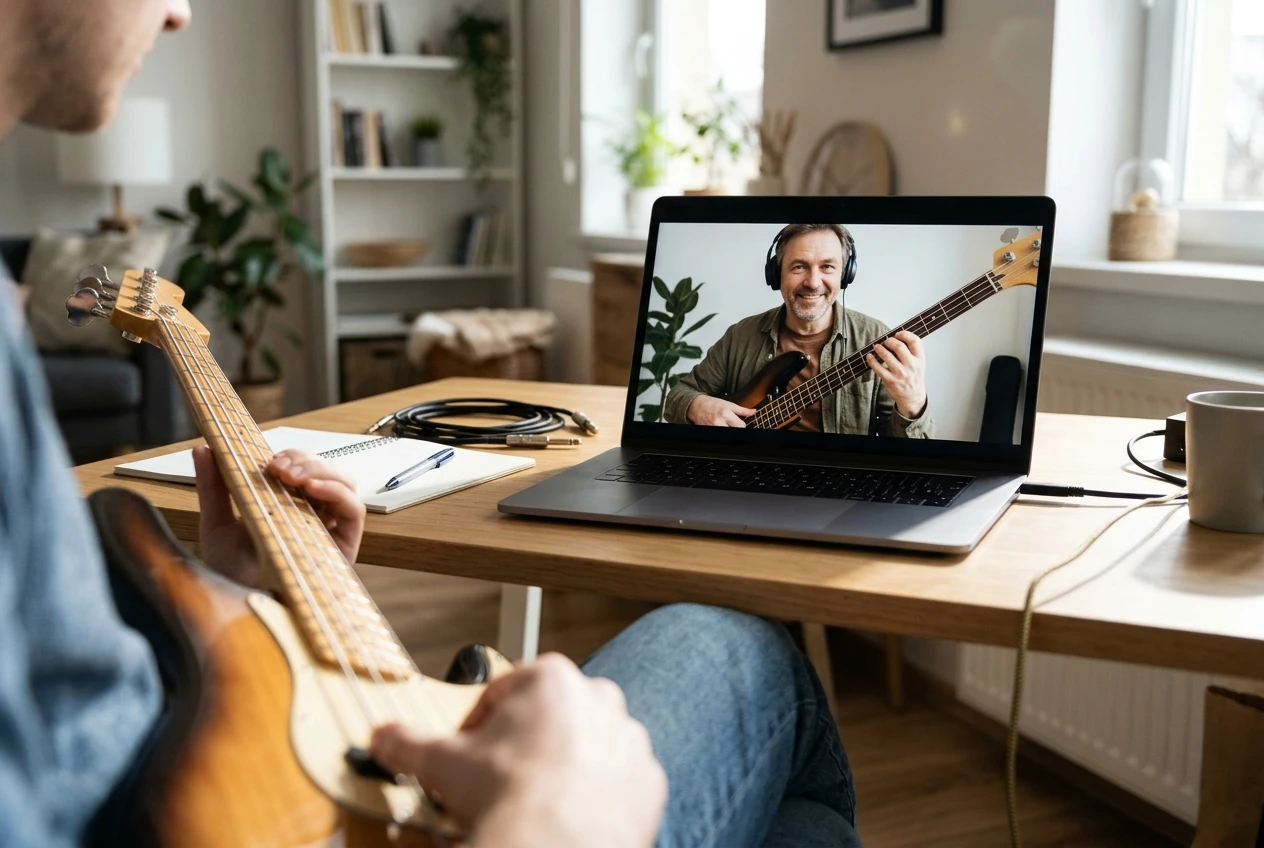
The cost is the obvious drawback. Paying per lesson makes this the most expensive option per hour. Scheduling matters too: fixed weekly lessons give you accountability, but they require your time at set hours, and missed lessons may or may not be rescheduled depending on the teacher’s policy.
Quality varies a great deal between teachers, and a video call has limits. Sound lag can make playing in time together impractical, so most teachers demonstrate, then listen to you play on your own. A trial lesson tells you quickly whether the teacher explains things in a way that suits you.
One-to-one lessons also work well in small doses. A single lesson every few weeks, used to check technique and set the next stretch of practice, costs far less than weekly tuition. This pairs well with a self-paced option for the days in between.
Best for: beginners who want technique corrected from the start, or who have already picked up habits they suspect are wrong.
Check before booking: the cancellation and rescheduling policy, whether lessons are sold individually or in prepaid blocks, and whether the teacher works with beginners.
Free YouTube lessons: how far they can take you before the gaps show
Free video can take a beginner a long way. You can find explanations of how to hold the bass, tune it, play your first scales and learn songs, usually by many different teachers. If one explanation does not click, another often will. For a first few weeks, or for testing whether you enjoy the instrument at all, nothing beats the price.
The gaps show up in order and sequence. Free videos are made one at a time, not as a curriculum, so you may learn a slap technique before you can keep steady quarter notes. Quality is uneven: some teachers show excellent technique, while others teach habits that make playing harder, and a beginner cannot easily tell the difference. Advice sometimes contradicts itself, for example on whether to use a pick, fingers or both.
You also get no feedback at all, and no accountability. Nothing tells you when you are ready to move on. Many learners end up with a long list of saved videos and a weak foundation.
You can reduce these problems by choosing one teacher or one playlist and following it in order for several weeks before jumping to something else. Treat it as a plain curriculum, not a buffet.
Best for: beginners on a tight budget, people trying bass before committing money, and anyone who wants to fill specific gaps in another option.
The comparison table: price model, feedback, structure, pace and cancel-anytime flexibility
This table describes typical patterns. Individual providers differ, so confirm the details on the product page.
Option Typical price model Feedback on your playing Structure Pace Cancel-anytime flexibility Video course platforms One-time purchase per course, or a membership Usually none; some add forums or video review High: ordered lessons Self-paced Varies; check access length and terms Subscription apps Monthly or annual plan, often with a trial Automatic scoring on notes and timing, little on technique Medium: guided exercises and songs Self-paced, with daily prompts Often monthly; confirm before choosing an annual plan One-to-one video lessons Per lesson or prepaid blocks Direct, from a person who sees you play Depends on the teacher Set by your schedule with the teacher Usually per lesson; blocks vary Free YouTube Free None Low: you build the sequence Entirely yours Nothing to cancel
Two patterns stand out. The options with the most feedback cost the most per hour, and the options with the lowest cost leave you to organize your own learning. Nothing here is free of trade-offs, so the useful question is which gap you can fill yourself.
Which one to pick based on your budget, schedule and goals
Match the format to your situation, not to a ranking.
- Very little money to spend: Start with free YouTube, following one teacher in order. Add a free practice tool and consider a single paid lesson later to check your technique.
- A modest monthly budget and a wish for structure: A video course or a subscription app gives you a path. Choose the one with a trial or short cancellation window, and film yourself occasionally to check your hands.
- You learn best with a person watching: One-to-one lessons, even every two or three weeks, are worth the cost. Use the sessions to correct technique and set practice goals, then cover the time between with a cheaper option.
- An unpredictable schedule: Self-paced options (courses, apps, YouTube) fit better than fixed weekly lessons. A teacher who sells single lessons with flexible booking also works.
- You want to play songs with friends or a band soon: Pick a format with play-along material, such as an app, and focus on root notes, steady timing and simple chord-following. The simple chord progressions for bass players page shows the patterns that come up most often.
- You want to understand the instrument, not only copy lines: Combine a structured course with scale and chord study. The bass scales for absolute beginners guide is a starting point.
- You are unsure you will stick with it: Choose the option with the lowest commitment. Free videos and monthly plans let you stop with little lost.
A reasonable first-90-days combination for many beginners is a structured source (a course or app), a regular practice routine with a metronome, and one paid lesson with a teacher after the first month to check your technique. You can add or drop pieces as you learn what works for you.
Fill the gaps for free: practice tools, tabs and metronome work to pair with any option
Whatever you choose, a few free habits make every format work better.
Use a metronome from the first week. Timing is the main job of a bass player, and no lesson format forces you to practice it. The guide on how to use a metronome for bass guitar explains how to start slowly and build up speed without losing accuracy.
Learn to read tabs. Tabs are the quickest way into your first songs, and most free and paid material uses them. The guide to reading bass guitar tabs covers the basics in a few minutes.
Warm up your hands. A short routine before playing helps your fretting hand build control. The finger exercises for bass guitar post gives you a set to run before each session.
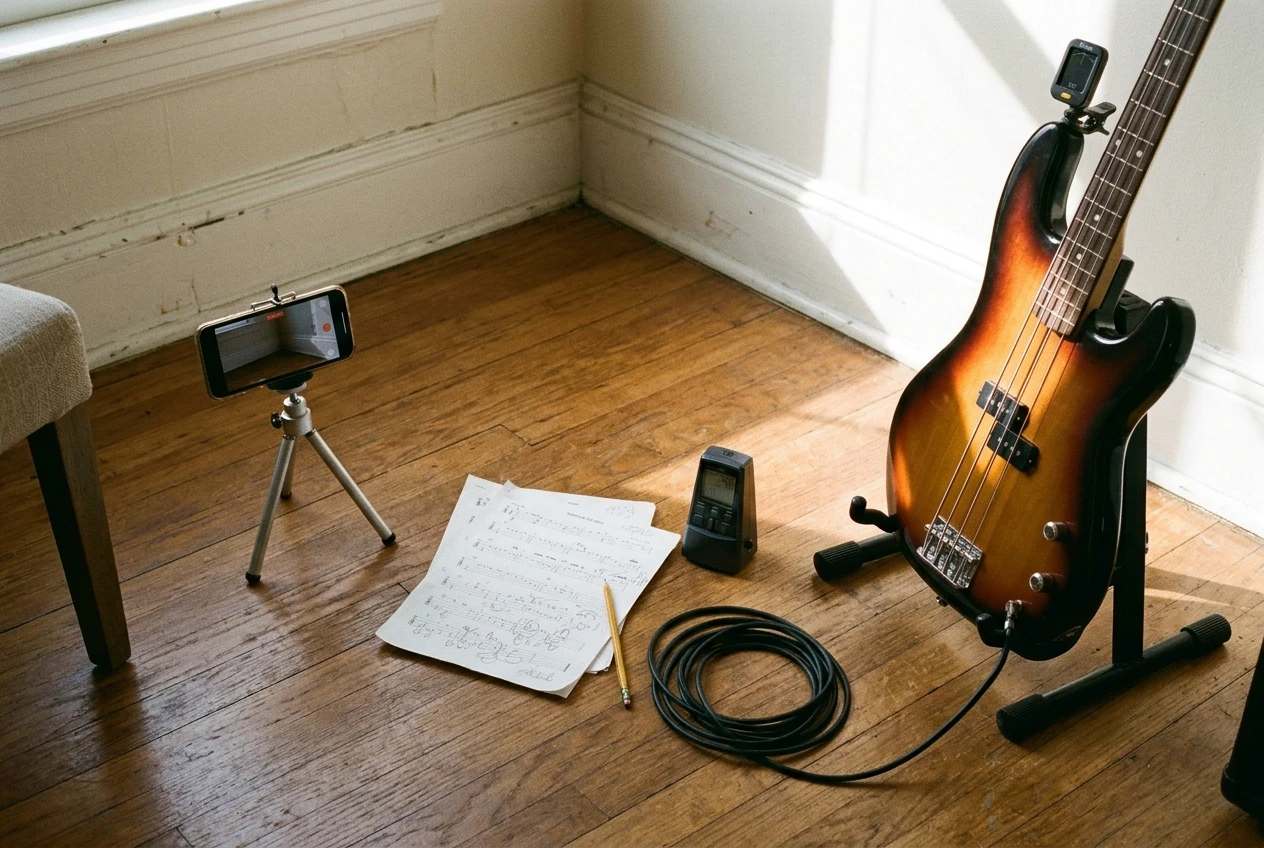
Record yourself. A phone recording gives you some of the feedback a teacher would, because you hear your timing and note length from the outside. Compare it with the track or the metronome and note one thing to fix next session.
Check your gear. A bass that buzzes or an amp you cannot hear properly makes everything harder. The page on best bass amps for beginners can help if sound is a problem.
Collect a few free practice tools. The bass guitar practice tools page lists useful ones, such as tuners, backing tracks and trainers.
Next steps
Pick one lesson option from the table, set a 30-day check-in with yourself, and keep your practice regular. Short daily sessions work better than a long one each week.
To support whichever format you choose, try Bass Skills Studio, the free practice app for beginner bassists. If you prefer a self-paced written route over video, the E Books For Bass Players page is the place to look.