
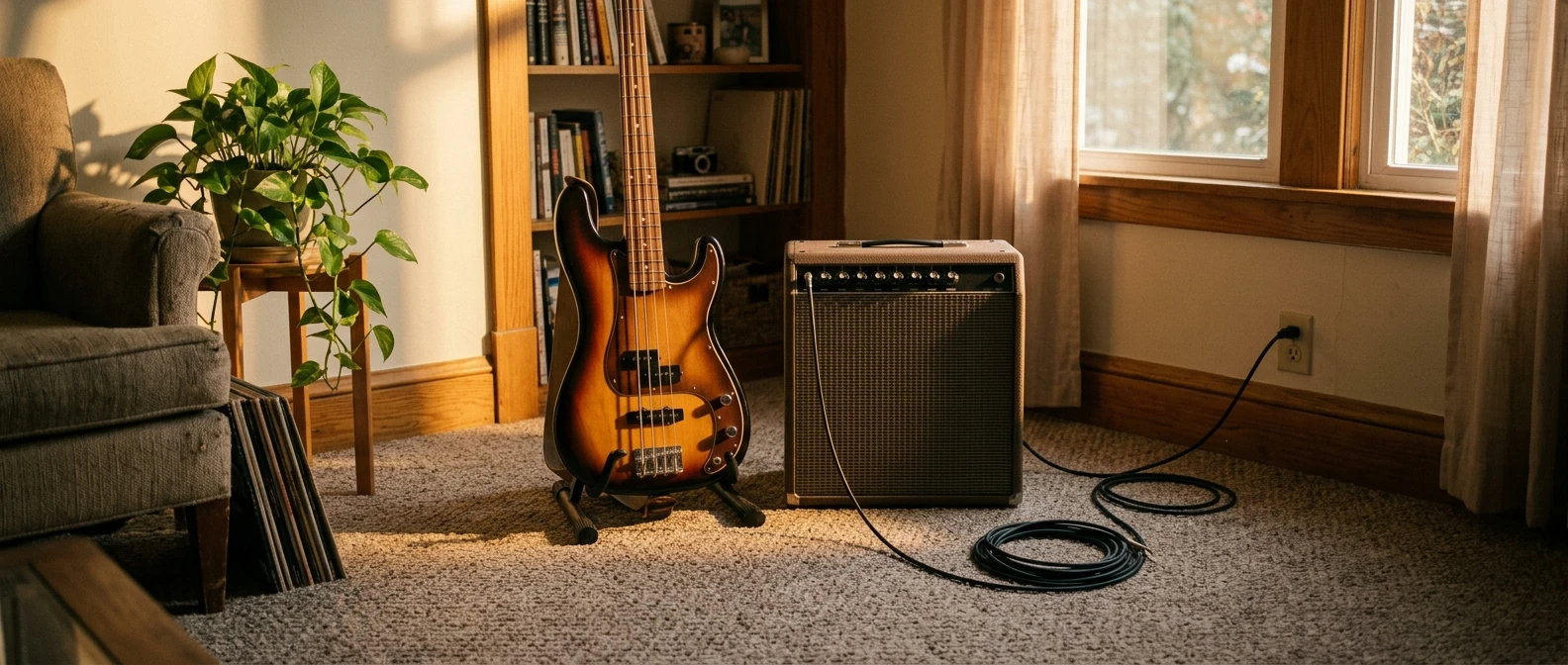
A bass and an amp get you through most of what you need to learn right now: scales, chord progressions, reading tabs, building bass lines. Pedals are not required gear for a beginner. But a few of them solve real problems that show up once you start playing with other people or recording yourself, and knowing which ones actually earn their price tag will save you from buying a pedalboard full of noise makers you never plug in.
This guide ranks the three pedals worth a beginner’s money, in the order to buy them, and tells you which popular categories to skip until you have outgrown a basic rig.
Do You Even Need a Pedal Yet?
If you are still working out where your fingers go and how to lock in with a drummer, a pedal will not fix that. No compressor smooths out timing that is not there yet, and no overdrive pedal makes a bass line sit better in a mix if the notes themselves are wrong. Time on the instrument matters more than gear at this stage.
That said, one pedal belongs in almost every beginner’s case from day one, and it has nothing to do with tone. A tuner keeps you in tune, which affects everything else you do on the instrument. Beyond that, the next two pedals on this list solve problems that come up specifically once you start playing with a band, recording at home, or running your bass through a PA. If none of that applies yet, the tuner is the only pedal you need. Everything else can wait.
The Only Three Pedals Worth Buying First
Walk into any guitar shop and the pedal wall looks overwhelming: fuzz, chorus, flanger, envelope filter, octave, reverb, delay, and a dozen boutique overdrives that all claim to be different. None of that is where a beginner should start.
Three pedals solve problems a new bass player actually runs into: a tuner, a compressor, and an overdrive. In that order. Each one addresses something specific, and buying them in sequence means you are never paying for a problem you do not have yet.
Tuner Pedals: The One Nobody Skips
A tuner pedal does one job: it tells you whether your bass is in tune, and it mutes your signal while you check. That second part matters more than it sounds. Tuning silently between songs, instead of plunking an open string through the amp, is the difference between looking like you know what you are doing and looking like you do not.
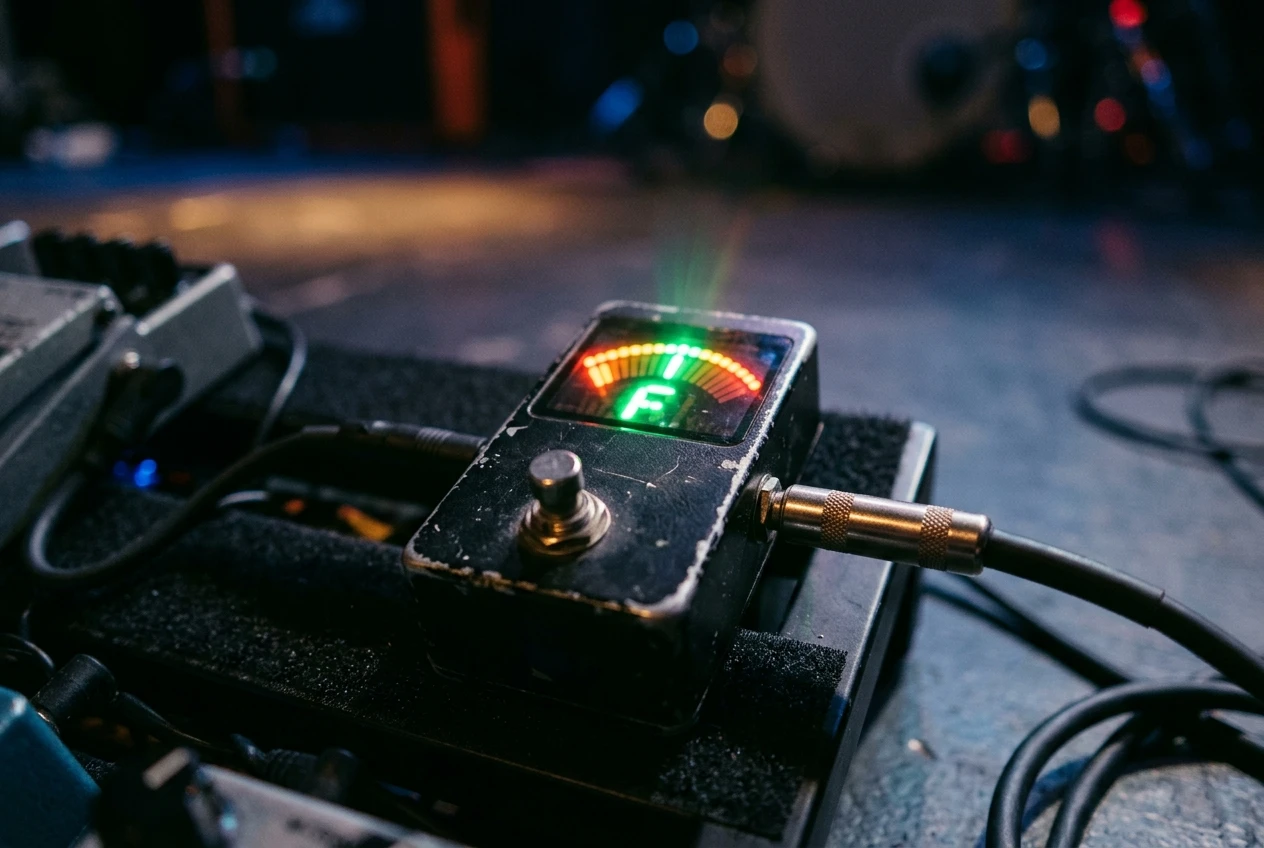
Clip-on tuners work fine for practicing alone at home. But the moment you plug into an amp, a pedal tuner is the better tool, because it sits in your signal chain and mutes the output the instant you step on it. You tune, you release, the sound comes back, and nobody in the room hears a thing.
This is also the cheapest pedal on this list and the one with the least room for disagreement. There is no tone to chase, no setting to get wrong. You buy a reliable tuner pedal once and use it for years.
Compression: Why Bassists Reach for It Before Overdrive
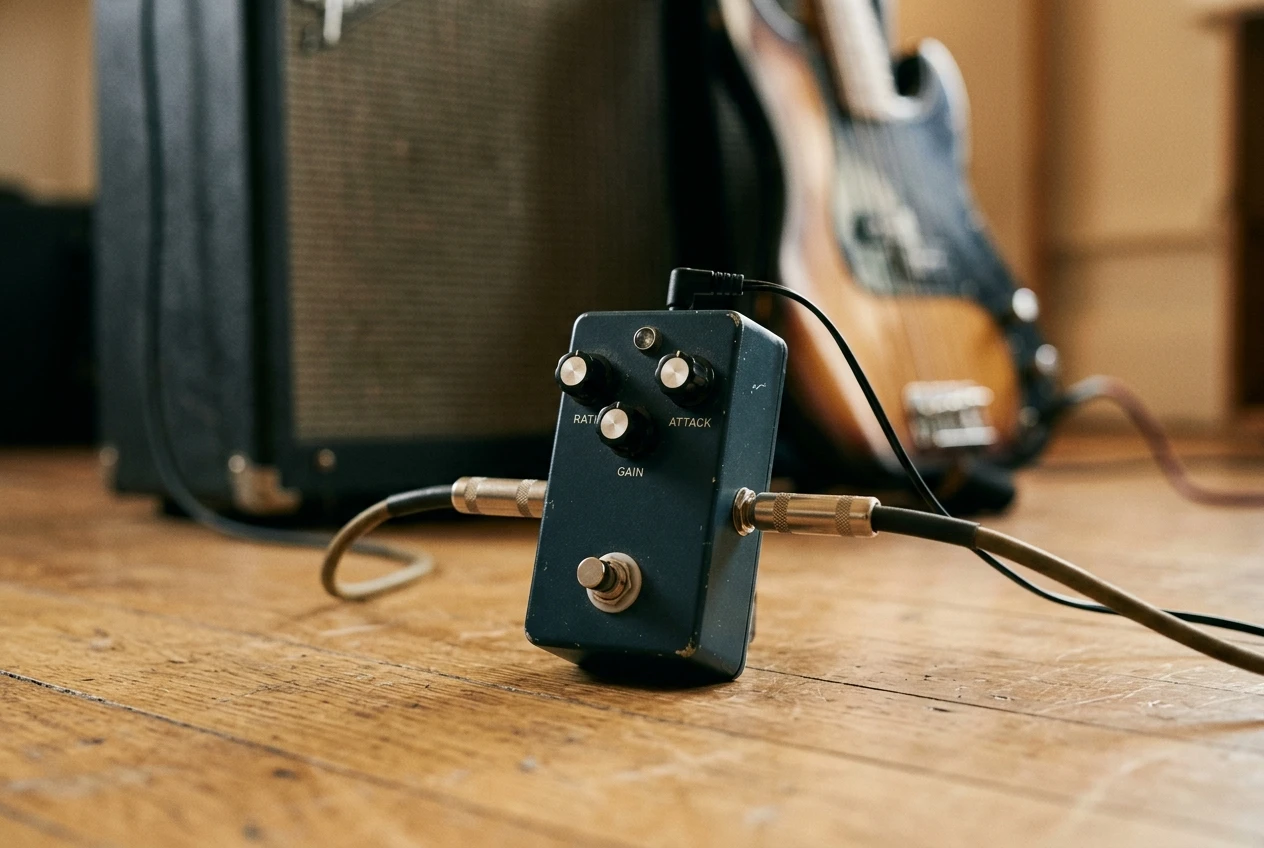
Guitarists usually reach for overdrive first. Bassists reach for compression, and there is a reason for that. Bass notes have a wide dynamic range: pluck softly and the note is quiet, dig in and it jumps. A compressor narrows that gap, evening out your attack so quiet notes sit closer in volume to loud ones.
The practical effect is a bass line that sounds more controlled and more “together,” especially for fingerstyle and slap playing where pick attack varies note to note. If you have worked through slap technique, you already know how much the dynamics shift between a fingerstyle passage and a thumb-and-pop line. A compressor smooths that transition instead of leaving your slap notes jumping out of the mix. For more on that technique itself, the guide on how to slap bass covers the mechanics a compressor is working with.
Compression also helps in a recording setting, where uneven dynamics are far more obvious than they are live. A compressed bass track sits in a mix more predictably, which is one reason engineers often add compression even when the bassist did not use a pedal.
Set a compressor wrong and it flattens your tone into mush, so start with light settings: a moderate ratio, a medium attack, and enough makeup gain to bring the compressed signal back up to a reasonable volume. Dial it in by ear rather than chasing a specific number, since every bass and every compressor pedal responds a little differently.
Overdrive and Distortion Without Losing Your Low End
Overdrive is the third pedal on this list, and it comes last for a reason: it changes your tone more aggressively than a tuner or compressor does, and it is easy to get wrong in a way that makes your bass disappear in a mix instead of cutting through it.
The problem with a lot of overdrive and distortion pedals is that they are built with guitar in mind. Run a bass through a guitar-voiced overdrive and you often lose the low end entirely, because the circuit filters out exactly the frequencies that make a bass sound like a bass. The result is a pedal that sounds great solo in your bedroom and vanishes the moment a kick drum and a guitar amp show up.
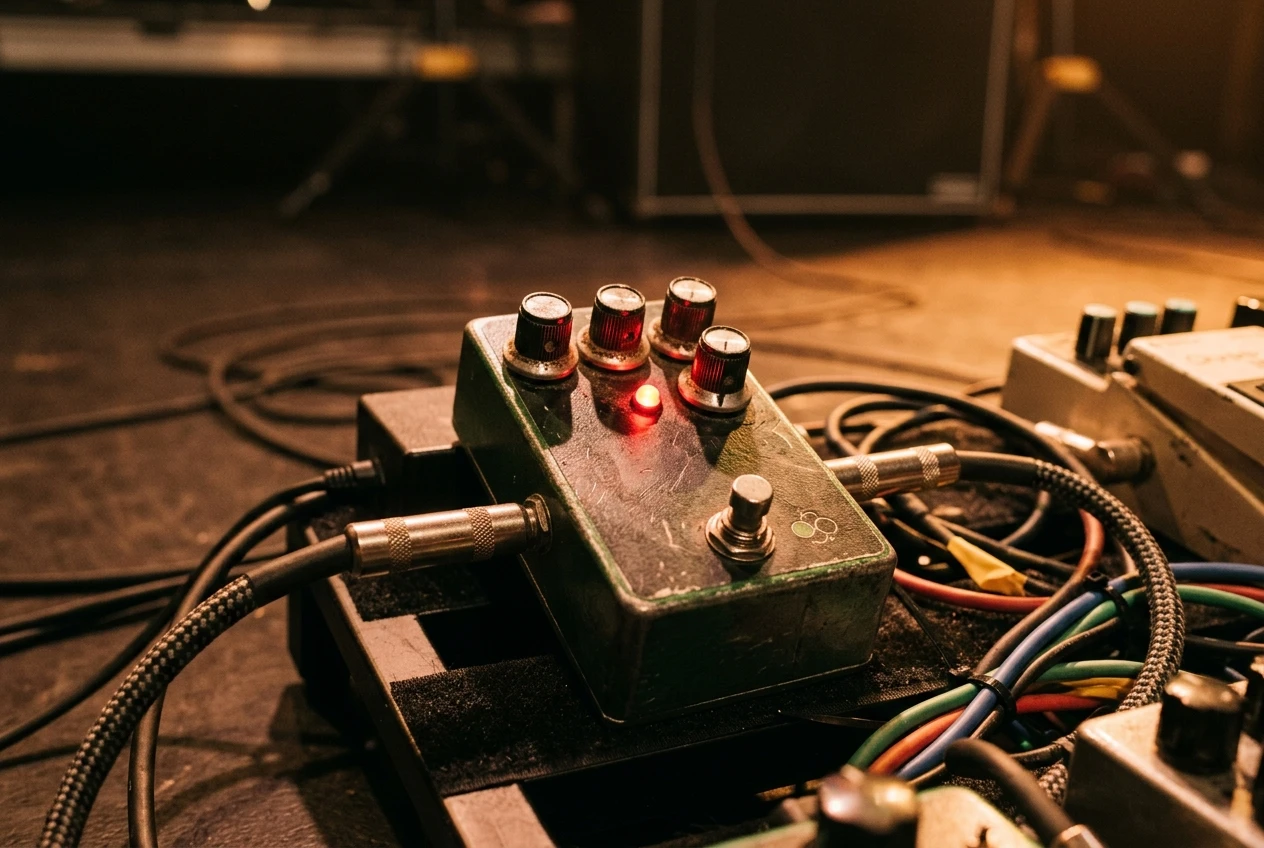
Pedals built specifically for bass usually include a blend control, which lets you mix your dry, unaffected signal back in with the overdriven one. That blend keeps your low end intact while still giving you the grit and harmonic edge overdrive adds on top. When you are shopping, that blend knob is the single feature worth prioritizing over flashier tone controls.
Overdrive is also the pedal most beginners reach for too early, because it is the most fun to turn on. Resist that order. A tuner keeps you in tune, a compressor makes you sound more controlled, and only then does an overdrive add color on top of a foundation that is already solid.
Where Pedals Sit in Your Signal Chain
Order matters once you have more than one pedal, and the standard signal chain for these three is simple: bass into tuner, tuner into compressor, compressor into overdrive, overdrive into amp.
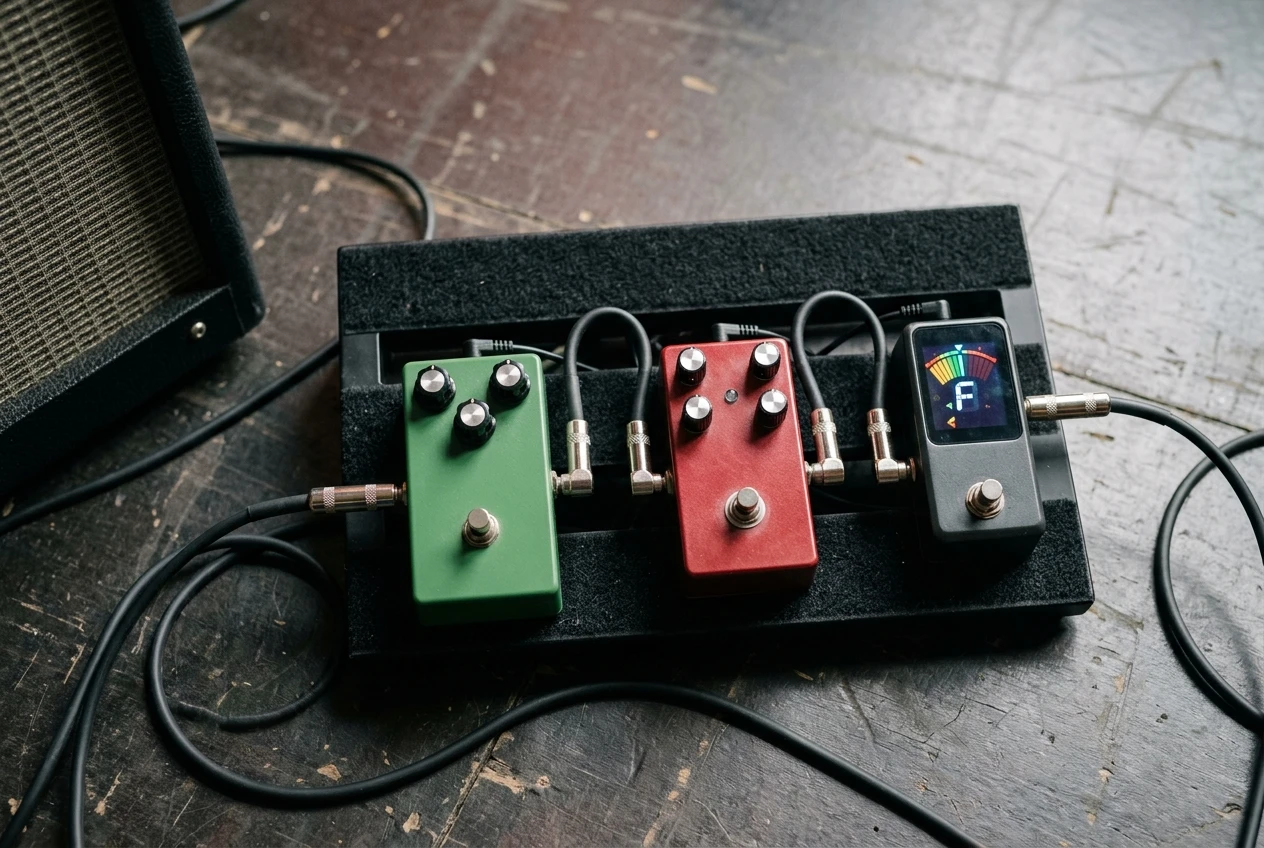
The tuner goes first so it reads your signal cleanly, before anything else has colored or compressed it. The compressor goes next so it is evening out your raw dynamics, not the dynamics of an already-distorted signal. The overdrive goes last among these three so it is reacting to a signal that is already controlled, which gives you a more consistent, predictable grit rather than unevenness on top of unevenness.
This is not a rule carved in stone. Plenty of bassists experiment with compression after overdrive for a different effect. But for a beginner building a first small board, tuner, then compressor, then overdrive, into the amp, is the order that will give you the most useful and least confusing results.
Pedal Categories to Ignore for Now
A few pedal categories show up constantly in gear demos and online forums, and almost none of them solve a problem a beginner actually has.
- Chorus and flanger: These add a watery, modulated texture that can sound interesting in isolation but often muddies a bass line in a full band mix. Worth exploring later, not worth buying now.
- Octave pedals: Fun for adding a synth-like low octave, but they are an effect, not a fix for anything, and they take real practice to use musically.
- Envelope filters: Great for funk tones once you know what you are chasing, but they are a deep rabbit hole of settings for a player who has not yet nailed basic tone and timing.
- Delay and reverb: These are far more common on guitar boards than bass boards, since bass frequencies tend to get muddy with heavy delay or reverb trails.
- Multi-effects units with 50+ built-in effects: Tempting because they look like a shortcut to a full pedalboard in one box, but a beginner ends up with dozens of presets they never use and none of the hands-on control a dedicated pedal gives you.
None of these are bad pedals. They are just answers to questions a beginner has not asked yet. Buy them once you know specifically what sound you are chasing and why, not because a demo video made them look exciting.
Building a Board One Pedal at a Time
There is no need to buy a tuner, compressor, and overdrive all at once. Buy the tuner first, since every player needs one regardless of style or genre. Add the compressor once you are playing with other musicians regularly or recording yourself and notice your dynamics are uneven. Add overdrive once you have a specific tone in mind you cannot get from your amp alone.
This slower approach also means you actually learn what each pedal does before adding the next one. A board built one problem at a time stays useful. A board bought all at once in a single shopping trip often has two pedals nobody ever turns on.
Pedals are one piece of a starter rig, not the foundation of it. If you have not settled on your amp or bass yet, the guides on best bass amps for beginners and affordable bass guitars for beginners cover the gear that actually comes before pedals in building out a first setup. And before buying any gear through links on this site, take a look at the affiliate disclosure page.